
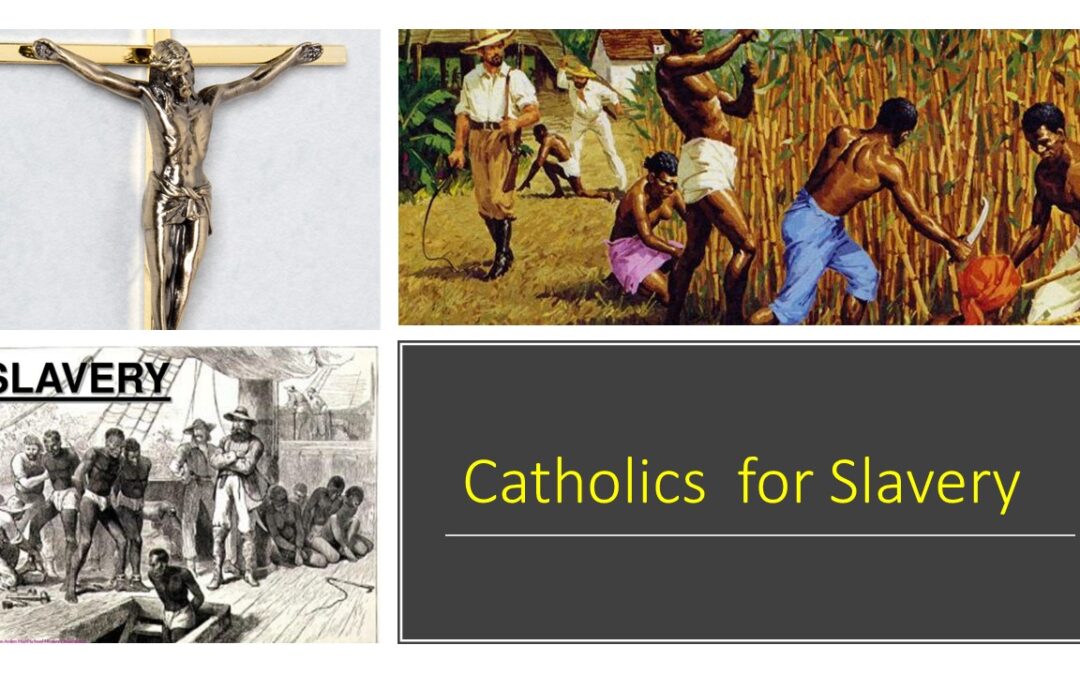
Catholics for Slavery??
The fake news and the real news, the social media, and the anti-social media, joined together in a rare display of unity to condemn a new group called “Catholics for Slavery.” As a committed Catholic, the Wise Guy is not happy about this group either.
Catholics for Slavery has joined a collection of offensive “Catholic” groups spouting questionable “Catholic” teaching. Two of the most prominent ones are Catholics for Abortion and Catholics for Gay Marriage, The Wise Guy has pondered these groups. Who funds them? Are they fronts? How many practicing Catholics are involved? Interesting questions the lazy CWG has never delved into.
But he seeks Wisdom about the Church’s Teaching and Practice regarding the ideas promulgated by these groups. Based on Church teaching and history, which ones are most likely to gain approval by the Church?
Let’s start with abortion. The Church came of age in pagan Rome which featured abortion, infanticide, and other forms of child abuse. The Church took a strong stance against these practices. It stood against abortion in the first century and in every century since. It has never wavered. The Catechism of the Catholic Church states,
Human life must be respected and protected absolutely from the moment of conception…From the first moment of his existence, a human being must be recognized as having the rights of a person – among which is the inviolable right of every innocent being to life…Since the first century the Church has affirmed the moral evil of every procured abortion. This teaching has not changed and remains unchangeable. Direct abortion, that is to say, abortion willed either as an end or a means, is gravely contrary to the moral law…Formal cooperation in an abortion constitutes a grave offense. The Church attaches the canonical penalty of excommunication to this crime against human life… (paragraphs 2270-2273)
Historical data on the involvement of individual Catholics in the practice of abortion is unknown but it’s safe to assume Catholics have had abortions and even performed abortions.
The Church’s teaching on human sexuality has also been clear and unwavering. It supports and blesses the Divine expression of physical love between a married man and woman. All other forms of sexual activity violate God’s purpose for the human body. This includes between persons of the same sex, whether “in love” or not. Since it is out of the question, gay marriage has never been explored in depth by moral thinkers of the Church, at least until recently. The Catechism of the Catholic Church states:
Homosexuality refers to relations between men or between women who experience an exclusive or predominant sexual attraction toward persons of the same sex. It has taken a great variety of forms through the centuries and in different cultures. Its psychological genesis remains largely unexplained. Basing itself on Sacred Scripture, which presents homosexual acts as acts of grave depravity, tradition has always declared that “homosexual acts are intrinsically disordered.” They are contrary to the natural law. They close the sexual act to the gift of life. They do not proceed from a genuine affective and sexual complementarity. Under no circumstances can they be approved. (Paragraph 2357)
As to practice, the Church has never officially performed a gay marriage but individual members along with priests and bishop have engaged in sexual activity outside of marriage, including gay sex. At times during its long history gay priests have plagued the Church, including during the sex abuse crisis in the late 20th century in America and elsewhere.
We conclude this section by noting that abortion and gay marriage are dark holes completely outside the Catholic moral universe.
Slavery is another matter and has occupied some constellations in the Catholic moral universe. The Wise Guy was disappointed and shocked to learn that the Church has a checkered history on slavery, both in teaching and practice. Slavery is not as fringe a Catholic idea as he would like.
The Old Testament accepted slavery, but gradually prohibited it for Jews. The New Testament, written during the rampant slavery of the Roman empire, never condemned slavery. Suffering waves of persecution themselves, the early Christian communities were in no position to challenge it. In one epistle St. Paul urges slaves to “…obey your human masters in everything…” (Col 3:22). But in a later epistle he writes about returning a slave to his master and urges the master to treat him, “…no longer as a slave but more than a slave, a brother, beloved especially to me, but even more so to you, as a man* and in the Lord.” (Phil, 16) Considering a slave “a brother” reflected progress in Christian thinking.
Here are a few depressing details of the next 19 centuries of the Church history.
Spread across the world, the Church was often a part of slave-holding societies and sometimes Church institutions held slaves; even various popes held slaves;
Two of our greatest theologians – St. Augustine and St. Aquinas – supported slavery;
Three Catholic countries played major roles in slavery in the New World: Spain, Portugal, and France;
Various popes condemned slavery, especially in the 18th and 19th centuries, but their words often fell on deaf ears.
But the light of Wisdom finally lit up the Church in the second half of the 20th century. During the 1960s, Vatican II condemned slavery. This condemnation was summarized in the Catechism, which many consider to be the final document of Vatican II.
The seventh commandment forbids acts or enterprises that for any reason – selfish or ideological, commercial, or totalitarian – lead to the enslavement of human beings, to their being bought, sold, and exchanged like merchandise, in disregard for their personal dignity. It is a sin against the dignity of persons and their fundamental rights to reduce them by violence to their productive value or to a source of profit. (Paragraph 2414)
Compared to the other two groups, Catholics for Slavery presents the strongest case for future support by the Church. If the Church once supported slavery, why can it not do so again? But the Church approving the ideas of any of these groups would be a step back into darkness, into the Dark Ages. Do we once again want to hide our light under a bushel basket? The Wise Guy certainly hopes not.
Pray with me this never happens.
Sources
The Bible
Catechism of the Catholic Church
“Let My People Go: The Catholic Church and Slavery” by Mark Brumley
Wikipedia, “Catholic Church and Slavery