
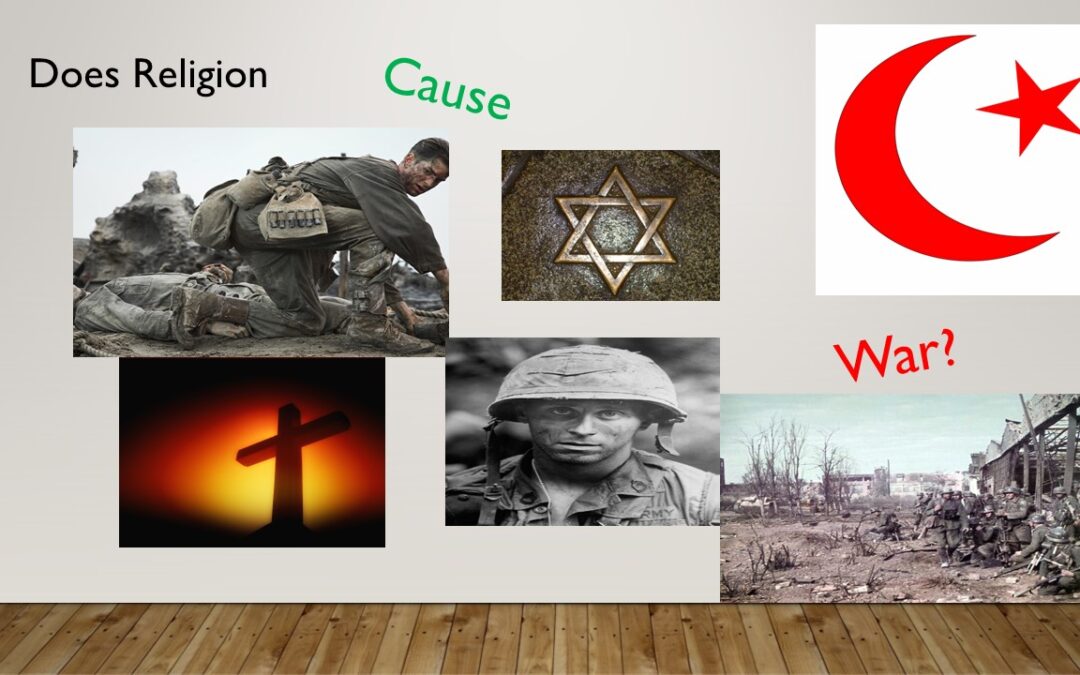
Does Religion Cause War?
Are Most Wars Caused by Religion?
The Catholic Wise Guy decided to investigate the oft-repeated claim that most wars are caused by religion. The corollary is if we could just get rid of religion, wars would cease, and worldwide peace would ensue. This concept is expressed with satanic beauty in the John Lennon song, “Imagine.” So, does religion lead to war or is this just another leftist lie? The Wise guy feels compelled to apply his limited talents to this question in his usual thorough and objective manner.
The vast landscape of human civilization daunts the Wise Guy, causing him to limit the scope of this essay to wars (primarily “Western”) since the American Revolution. He closes this section by quoting from the Wikipedia article titled “Religious War.”
“According to the Encyclopedia of Wars, out of all 1,763 known/recorded historical conflicts, 123, or 6.98%, had religion as their primary cause.” Religious war – Wikipedia”
The Wise Guy agrees with historians who observe that in most conflicts it is difficult to separate and weigh “religious” factors compared with ethnic, political, and economic factors. All are boiling away in a toxic brew that leads to the dark place where men are willing to kill other men. A short essay like this cannot do justice to all the complex factors that cause men to take up arms. We focus on the main points.
Religion was not a primary or secondary cause in the following wars:
American Revolution – 1775-81
Napoleonic Wars – 1800-1815
Mexican American War 1846-48
American Civil War 1861-65
Franco Prussian War 1870-71
World War I 1914-1918
World War II 1939-45
Chinese Civil War 1944-1948
Korean War 1950-52
Vietnam War 1961-1973.
The Wise Guy highlights the fact that religion did not play a significant factor in either war the two World Wars – the bloodiest, most destructive wars in human history. In WWI, the primary cause was the German drive for hegemony in Europe. All the major combatants were nominally Christian except for the Ottoman Empire. In WW II, German aggression was heavily seasoned with Nazism, a political-racial ideology that proved particularly destructive. Political objectives dominated this war – Fascism vs. Communism, and Fascism vs. the Western Democracies. The Japanese drive for hegemony in Asia included the concept of the superiority of the Japanese race.
Religion may have been a primary or secondary cause in the following wars:
Russian Revolution and Civil War 1917-1922. Religion could be considered a secondary cause. Lenin and his Bolshevik party overthrew the Czarist regime – which was officially Christian – and established communist rule, which was atheistic. Lenin succeeded and the communists persecuted Christianity and other religions until the fall of the Soviet Union in 1991.
The Cold War 1946-1991. Religion could be considered a weak secondary cause. This war was called the “Cold War” because the principal parties, the United States and its allies versus the Soviet Union and its allies, never directly confronted each other on the battlefield. There were many proxy wars across the world, including the Vietnam War, but no direct confrontation. The presence of nuclear weapons on each side contributed to this pattern of avoiding a “hot” war. The Western Bloc was generally Christian while the Soviet Union and its allies were atheistic.
Israel & Arab Wars 1948–present. Religion could be considered at least a secondary cause of these wars, perhaps a primary cause. These major wars (1948, 1967 & 1973) and on and off again uprisings feature the Jews on one side and the Muslim Arabs on the other. However, it’s difficult to apportion the percentage responsibility among religious, ethnic, and political factors. This instability in the Middle East was accelerated by the creation of the Jewish State of Israel in 1948 amid a sea of Muslim Arabs. The Arabs dislike the Jews as an ethnic group and for taking away some of their territory. Islam itself has a strong anti-Jewish element.
Irish-British “Civil War” Off & On in the 20th Century. Religion could be considered at least a secondary cause of this war, perhaps a primary cause. On one side were the Catholic Irish, on the other the Protestant British. However, again it is difficult to separate the Catholic/Protestant component from the Irish/British. The Irish disliked the British and their heavy-handed control of their country.
Wars in Iraq & Afghanistan 1991–present. Religion could be considered at least a secondary cause of these wars, perhaps a primary cause. At one level, this was the “Christian” West versus the Muslims of the Middle East. However, this analogy breaks down under a more detailed analysis. First, the West was not very “Christian,” and the spread of Christianity in the Middle East was never a war aim of the U.S. and its allies. And in these two wars, the West aligned itself with various Muslim groups to fight other Muslim groups.
Islamic Jihad 1991-present. Religion could be considered at least a secondary cause of this war, perhaps the primary. The Islamic Jihadists proclaim this a holy war, a religious war against the Infidels and the Christian Crusaders, making this at least a “one-sided” religious war. Islam has a distinguished history of military conquest in the name of Allah. The opponents of the Jihadists – moderate Muslims, Western democracies, and other countries – do not consider this a religious war. They see it as a defensive fight against Muslim terrorists who are trying to destroy their way of life.
Many of the opponents are not overtly religious, particularly the leaders and people of the Western democracies. The war aims of Jihadist groups differ. Some want to seize rule in their country, drive out the Crusaders, subdue other Muslim factions, and establish Sharia law. Other Jihadists aim to establish an Islamic caliphate (e.g., ISIS). The Jihadists fight primarily with weapons of terror, attacking civilians in their places of work, leisure, and worship.
The Wise Guy hopes you have reached the same conclusion as he has – religion is rarely the cause of war. Those who assert otherwise speak falsely. The Wise Guy is intrigued by a related question, “Does the absence of religion cause war?” That’s the subject for another essay.
Peace, brothers and sisters.
I invite you to check out my other essays, stories and poems . . .