
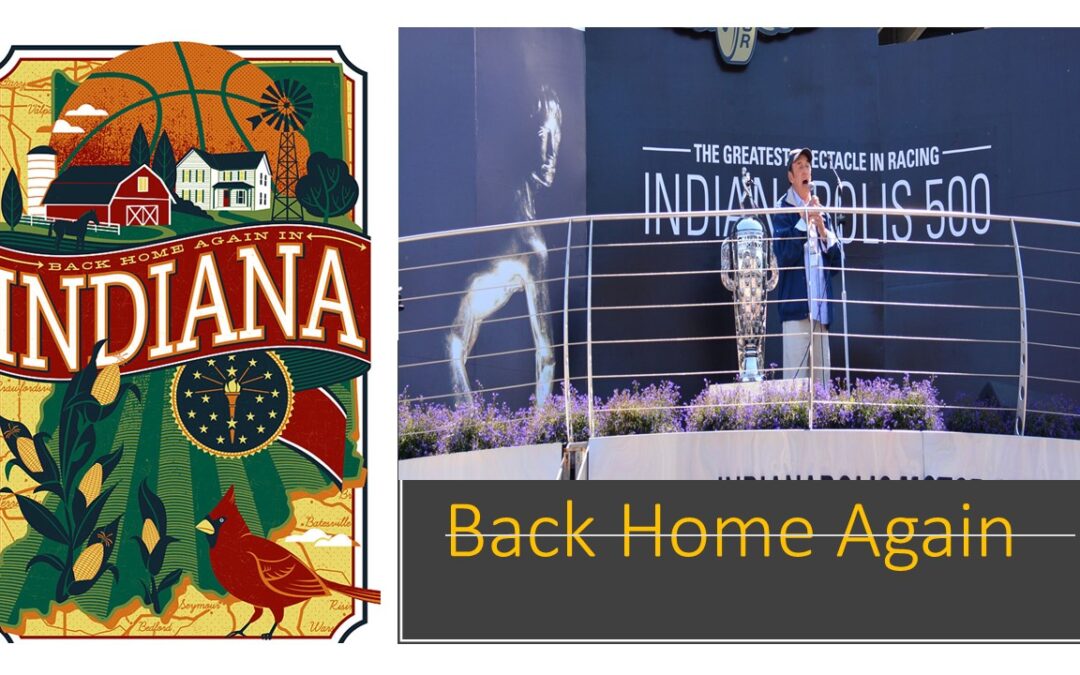
Back Home Again In Indiana
Sleek and loud the cars were running. Dean Chesterton sat uncomfortably on the aluminum bench seats in the North Vista at the Indianapolis 500 watching them. On the cloudy race day with his wife Lorraine sitting beside him and surrounded by members of his Funds Distribution Division (FDD) and other personnel of the Systems Directorate (SD) at the Army Finance Center, Dean felt satisfied, good. He liked going to the 500, especially if it solved the work problem.
This trip to the track had begun with the feisty behavior of Johnny “Red” Dolan, an accountant who worked for Dean – worked for him to the extent that Red worked for anyone. Red nearly took a swing at one of the Data Dictionary (DD) people at a systems interface meeting. The young man dared critique the data elements in the Funds Distribution System (FDS) standard interface record Red had developed to pass funding data to other systems.
Red became unhitched and began cantering towards the loosely hinged gate on the ranch of Accountant Professional Behavior when the DD accountant observed, “The System Directorate Interface Standards state that all data elements in interfaces must conform to the SD data element dictionary. And the proposed FD interface has several data elements not in the dictionary.”
Now Red had reservations about leaving the ranch – conduct unbecoming an accountant would not enhance his career. He could use some extra income, as supporting his previous and current wives as well as two children, one a never-do-well teenager and the other a college student, was becoming burdensome. Yes, he wanted the money and the recognition his ability merited but -, but the truth was fools should not be given a free pass. That would only encourage them. Only a fool suffered fools gladly, and Red was not a fool. When God had poured out all this abundant intelligence on a backwoods Alabama boy, He had also laid on him the responsibility to curtail a bit the tomfoolery of the world.
The data elements Red had proposed in the interface were already in the Department of Defense (DOD) standard element dictionary. It was the task of the Systems Directorate DD clowns to catch up with the DOD standards, to bring their damned dictionary into compliance; it was a task they had failed at. What particularly grated Red was they did not realize the problem, did not fathom their own incompetence.
He tried – for a few seconds – to calm himself and continue to present his case but realized the DD accountant – whose hair was unbecomingly long – wasn’t listening and then, a young woman who accompanied the DD accountant, probably a recent college graduate, proceeded to repeat what her companion had just said, as if Red were hard of hearing. Red stood up, swore softly, threw his pencil and papers up in the air, and – ever the Southern gentleman – ignored the woman and reached across the table towards his male tormentor. He grabbed his tie and yanked at it. Being a clip-on tie commonly used by government professional employees, it came off in Red’s hand, causing him to fall forward.
Dropping the tie to the grey government table, Red steadied himself. Clenching his fist, he straightened to his six-foot height, and said loudly, “You, sir, are a data element dunce – a damned DDD – and should never be let out of your dark stupid dungeon again.” He glanced at the two terrified DD people and added, “Put your damned dunce caps back on and return to your corners.” Red calmly gathered up his pen and papers and started to leave the room, motioning with his eyes to his team leader Matt that it was time to go. Near the door, Red turned and concluded the interface meeting by saying, “Do not trifle with me again.”
The meeting had lasted less than the scheduled hour.
Walking back to the FD Office with Matt, Red said he would be damned if he would let a few snotty young accountants who had graduated from stupid, politically correct Yankee universities ruin the solid work he had put in developing the interface. He was goddam tired of having to fix the screw-ups of others in the Systems Directorate. Matt half-listened, imagining how he would explain this to Dean. Matt finally stopped Red’s rant with the words, “Enough already, Red.”
After the interface incident Dean fumed, mad at Red, frustrated with Matt, and concerned what the Colonel and Mundane would think of his management skills, since he had gone out on a limb to hire Red. In systems you needed smart creative aggressive people, not the usual non-boat rockers endemic in Civil Service. Of course, Red had been a known commodity: a brilliant madman, a ticking time bomb set to explode when ticked off. Hiring Howard Land had been part of Dean’s plan to control Red. And it had worked rather well. Who could explain the bond between the mercurial rightwing Southern backwoods boy and the bland friendly Hoosier who neither hid nor trumpeted his gayness? Whenever Red began cantering towards the gate of the Professional Behavior Ranch Howard would put his hand on Red’s shoulder and say, “Come on now, Red. Calm down, calm down. It’s not that big a deal. Don’t make a mountain out of a molehill.”
So, Howard was on vacation in some gay resort in Florida, the interface was Red’s baby, and the meeting had been scheduled for a month, so with some misgiving Dean had sent Matt with Red, hoping Matt could keep Red corralled on the ranch. Matt was an excellent team leader and supervisory material but ultimately no one controlled Red. Red could not control Red.
Dean’s counseling session with Red fared badly. With a wry smile Red accepted Dean’s comment that an interface meeting was not an in-your-face meeting. When Dean told Red he was sending him to an Anger Management Class, Red replied that his wife had suggested that more than once he attend such a class and he would gladly attend one at government expense under one condition.
“What’s that?” Dean asked.
“The DD people have to attend a Stupidity Management Class.” Red paused and added, enunciating each letter, “SMC.”
Dean looked at Red’s smiling red face. It was an honest face: Red looked the alcoholic Irish Southern Boy he was. He glared at Red, saying he would talk to the Colonel about that. Red left the office with Dean unsettled and nothing settled. Dean lit his pipe and puffed quietly for a few minutes. He smiled, imagining how Human Resources would respond if he called and inquired about sending a few employees to their Stupidity Management Class.
That day Dean did, however, settle on one thing: if Red ever happened to be in the office without Howard, Dean would not would absolutely not send him to any government gathering to represent FD, even if the Lord himself volunteered to accompany him.
After the interface dust-up, the Colonel – in Dean’s opinion at least – overreacted, deciding the Systems Directorate needed more team building and that attending the Indianapolis 500 together was a good first step. The problem was Red, not the entire directorate; most of the people got on swimmingly. Or at least they didn’t mind being in the same pool. And the FD division could not afford any more unproductive time for Red or anyone else.
Selling the 500 to the FD team proved easier than Dean thought. Other SD divisions bought in as well. It helped that the Finance Center received several hundred discounted seats to the race each year for DOD military and civilian members. They were decent seats on the short chute between the third and fourth turns; being sold at less than half-price sweetened the deal.
Howard agreed to come and keep Red under control. Howard in fact helped organize the day for FDD, including the food and drink. He was not that great an accountant, but he certainly helped the organization run smoothly.
Not born an open-wheel racing aficionado, Dean had become a casual race fan. Watching the Indy cars chase each other around the two-and-a-half-mile track with four left-hand turns for three plus hours over five hundred miles often bored him. But there was excitement too. It reminded Dean of his Vietnam service: long periods of boredom punctuated by moments of excitement and terror. As if the cars were not naturally loud enough, their roar was amplified and echoed by the loudspeakers that lined the fence around the track. The exhaust fumes hung in the air like smoke from a battle.
Living in Indy and not seeing The Greatest Spectacle in Racing was like living in Colorado and not snow skiing. Dean had first gone to the race in 1964 with his father. An executive with Eli Lily, Michael Chesterton had obtained good seats near gasoline alley. Prior to the race the Purdue Band had played the National Anthem, and Vic Damone had sung “Back Home Again in Indiana.
“Back home again in Indiana oh it seems that I can see,
That gleaming candlelight still burning bright,
Through the sycamores for me;
That new mown hay sends all its fragrance,
From the fields I used to roam,
Oh, I dream about the moonlight on the Wabash,
Then I long for my Indiana home.”
Dean did not like Vic Damone’s smooth voice or the simple syrupy song about his home state, which no one considered overflowing with natural beauty, unless you saw a special beauty in shining green flat fields full of healthy corn and soybeans. Or your astute eyes noticed something particularly esthetic about a well-run pig farm.
Dean admitted the Wabash was a nice river with some beautiful, sweet spots, but he doubted it looked as good as it did in the heyday of the Miami Indians. He granted that some nights the moonlight on the Wabash looked particularly beautiful and conceded that new mown hay could smell quite good but if those were the only praises the state merited that wasn’t saying much.
He and his father experienced boredom and excitement during the greatest spectacle along with sorrow and tragedy when Sachs and McDonald died in a fiery crash. A.J. Foyt led most of the way and drank the Indiana milk in the winner’s circle. The “Greatest Spectacle” stood out as the best-attended sporting event on the planet. The next day the Star said the crowd was over 275,000. Dean had drunk a lot of water and Coke that day, but their seats had been shaded from the sun, and he did not suffer the sunburn evident on many of the faces, arms, and shoulders of fans as they exited the track. The traffic, crowds, and race made the “Greatest Spectacle” an all-day affair. Like most of the fans, the Chesterton’s had brought food and drink into the track in a cooler.
After the race as they trudged along among the throngs, taking turns lugging their cooler several miles to their car. Michael Chesterton said to his son, “I think this is a once every few years deal.” Dean nodded in agreement.
Race day arrived cool and cloudy. It was Sunday, May 27th, 1984. Rain was predicted for the late afternoon, and the crowd wondered whether the race would be completed. Indy cars did not run in the rain.
Dean surveyed the stands, what he could see of them. With his binoculars he could see the 33 cars had been pushed onto their starting position on the track, and the teams swarmed around them, preparing for the race. The colonel’s idea was turning out better than expected though Dean noticed all the FD people sat together. Same for the other divisions. Not a lot of systems integration. Not a lot of personnel integration. Red’s two favorite DD accountants were present and sat as far away from him as possible.
As Jim Nabors sang “Back Home Again in Indiana” Dean traveled back 14 years to another of his Indy 500 experiences. He was back in The Nam again.
Third platoon of Bravo Company returned to Da Nang after five days in the bush, dirty and dog-tired. The men had slept little on patrol. They rotated sleeping on night ambush, but it was an uneasy sleep. You trusted your buddies but still were afraid of waking with a gook pointing a rifle at your chest. Sleeping in the heat of the day wasn’t easy either, even in the shade.
Dean and his war brothers returned without battle wounds though many had nasty red ant bites from setting up the first night ambush by a series of red ant nests that hung low in the trees. The men were pissed at Lt. Needleton for not moving from that spot faster and then for getting lost and nearly doubling the time on patrol. From then on, they referred to him sarcastically as “maphead.” After that patrol, the first sergeant always carefully reviewed the maps with the lieutenant, who was from a flat farm in Kansas and had trouble navigating the un-flat Vietnamese countryside.
The lieutenant wasn’t a bad guy and his actions on that patrol did not reach fragging level. The red ants – unable to distinguish an officer from an enlisted man – bit the lieutenant too so at least there was some justice in the world. He was slow to move from the ambush position because Schneider was on point and had whispered back that he saw some gooks coming their way. So, they lay in wait, the dark quiet night interrupted by muffled slaps and groans as the GI’s battled the ants. The gooks never came their way, and in the morning the men joked the only ambush executed was by the red ants. That patrol Dean had used up all his insect bite treatments in his medic bag and several men went to the hospital for further treatment when they returned to Da Nang.
After showering Dean debated sleep versus food and opted for the food. A beer sounded good too. He had humped beyond tiredness and felt a surge of energy. He and Stryker walked to the enlisted club. Dean scarfed down bacon and eggs, toast, and a glass of orange juice.
Dean asked, “Stryke, you’re getting short short, aren’t you?”
“Damn straight. Fourteen and a wake-up.”
“I’ve got 50 left.”
“I’m paranoid as hell about getting wasted.”
“We should have safe jobs the last 30 days,” Dean half-joked.
“Damn straight, Deano, damn straight. Can’t possibly make it through 350 plus days and then get wasted at the end. That would be damn unfair.”
“I’ll talk to the captain,” Dean continued the joke.
“It’s too late for me,” the Stryke said, “but maybe I’ll write my congressman when I get home and drum up support. Of course,” he continued, “there’s always duty.” He ran his hands over his unshaven face and rubbed his young soldier’s eyes, “But really, I’ve had enough of duty. It’s time for some other patriotic dumbass to do his duty.”
The Stryke was sure zigging and zagging today. “You know, Deano,” Stryker continued, “I don’t really hate these damn gooks. I’m in their fuckin’ block, they’re not on my block. In Philly we used to say you leave me alone on my block and I’ll leave you alone on your block.”
“You’re right – they’ve never been on your block. Or my block. But we’re camped out in their block with a lot of guns and a mean attitude.”
“Just get home safe – that’s all I want. Forget God and country and love and all that other shit. Just bring me home in one piece.”
The Armed Forces Radio Network announced they had a special treat for all racing fans out there. They were going to broadcast a tape-delay of the Indianapolis 500, “The Greatest Spectacle in Racing.” Then it hit Dean: it was Memorial Day weekend. In theory, people back in the world were honoring current and former GI’s. Dean knew that Vietnam Vets had not received a lot of honoring lately, especially on college campuses where he planned to be soon. But the thought that some Americans other than his family would be thinking about him touched him.
He had planned on returning to his hooch to sleep but decided to listen to the start of the race. Indy was his home after all. He got two beers, one for Stryker and one for himself. They listened to the radio, which was mounted on the wall of the club. Someone – Dean did not catch the name – began singing “Back Home Again in Indiana.” The short song ended with this line:
“Oh I dream about the moonlight on the Wabash Then I long for my Indiana home.”
A wildfire of emotion rushed through Dean, flashing through the hot muggy cynicism of a twenty-year old. A few tears slid down his face; he was embarrassed and wiped them off with his sleeved arm. What would the Stryke think – what would his Bravo company brothers say? He struggled to control himself, but more tears came. A cry escaped his lips. Stryker looked at him and other heads turned. Dean held up his hand, and then buried his face in his arms on the table.